Picking the right medication isn't just a matter of intuition. Your familiarity with the brand isn't even enough. You need to know what to read on the package.
A familiar packet can feel reassuring when you have a headache, cold, or another minor symptom. Yet different brands can contain the same medicine, and one product can contain several ingredients. A short label check helps you ask better questions before taking a dose or buying another remedy.
Thrive Key
– Read the active ingredients, not only the brand name or symptom claim.
– Check strength, directions, warnings, and other medicines already taken.
– Ask a pharmacist when the instructions or suitability are unclear.
– Possible overdose needs urgent advice even if the person initially feels well.
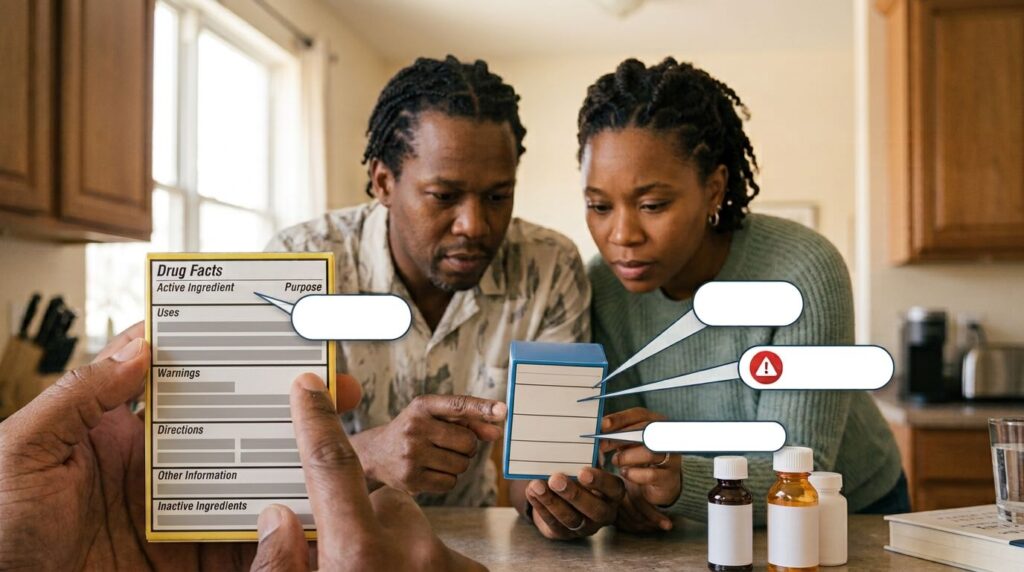
Start with the product in your hand
Read the current packet rather than relying on what the brand used to contain. Formulations, strengths, and age ranges can differ, including between countries. Similar colours or names do not establish that two products are interchangeable.
The FDA explains the sections of the US Drug Facts label, including active ingredients, uses, warnings, and directions. Other countries use different layouts, but these are still useful categories to locate. [1]
Keep the leaflet and packaging with the medicine. If tablets are loose or the label is missing, do not identify them by colour or shape alone. Ask a pharmacist before using a product you cannot reliably identify.
Find the active ingredient first
The active ingredient is the substance intended to produce the medicine’s effect. A brand name is the name used to market the product. Write down the ingredient if it is unfamiliar and ask how it relates to anything you already take.
For example, acetaminophen and paracetamol are names for the same medicine. That matters when products come from different markets or a relative brings a familiar brand from abroad. [2]
A cold remedy may contain a pain reliever alongside other ingredients. Do not assume it is separate from a pain tablet simply because the front of the box mentions congestion, flu, or night-time relief.
Compare products before combining them
Put the packets side by side and compare every active ingredient. Include prescription medicines, nonprescription products, and anything taken earlier that day. A list is useful when several people help with care.
FDA guidance warns against taking more than one acetaminophen-containing product at the same time unless appropriately advised, because accidental excess can cause serious liver injury. [2]
The broader lesson is to check combinations with a pharmacist rather than assuming different brands mean different medicines. Do not create your own alternating schedule from internet comments. If a clinician has provided a specific plan, keep it written and clarify anything that seems inconsistent with the packet.
Read strength and formulation carefully
An ingredient name alone does not tell you the amount in each tablet, capsule, sachet, or measured volume of liquid. Check the strength and the unit shown. “One spoon” is not a sufficiently precise instruction for a liquid medicine.
Use the measuring device supplied or recommended for that product, and ask for a demonstration if needed. Do not use a kitchen spoon as a substitute. If a dose is stated in millilitres, make sure you understand the markings on the device.
Also check whether the product has special directions for swallowing or preparation. Do not crush, split, dissolve, or open a formulation unless the label or pharmacist confirms that doing so is suitable.
Follow the whole direction, including the limit
Read the amount per dose, interval between doses, maximum allowed, and how long the product should be used before seeking advice. These details work together. Taking a smaller amount does not automatically make taking it more often safe.
FDA consumer guidance stresses using nonprescription pain relievers only as directed and avoiding excess amounts or longer use than advised. [3]
This article does not supply a dose because products and individual circumstances differ. Use the instructions for the exact medicine and person involved. If symptoms return before the next permitted dose, ask for advice rather than shortening the interval to keep up with them.
Treat warnings as a checklist for you
Read the conditions, medicines, allergies, and circumstances listed under warnings. Relevant details may include stomach bleeding, kidney or liver problems, blood pressure, or medicines that affect clotting, depending on the product.
FDA guidance describes interactions between drugs, food or drink, and health conditions. A medicine being available without a prescription does not mean it is suitable for every person. [4]
Bring your regular medicine list to the pharmacist, including supplements and herbal products. Say what you are trying to treat and how long it has been happening. The pharmacist can then assess the actual combination instead of answering a vague question about whether a brand is generally safe.
Ask before using medicine in pregnancy
If you are pregnant, might be pregnant, planning pregnancy, or breastfeeding, ask an appropriate professional about the specific product. Do not treat a familiar nonprescription medicine as automatically suitable.
FDA warns against NSAIDs, such as ibuprofen or naproxen, from around 20 weeks of pregnancy unless a healthcare professional specifically directs their use. A clinician-prescribed medicine, including low-dose aspirin in certain circumstances, should not be stopped independently. [5]
The question should include the ingredient, dose form, and reason for use. If you have already taken something and are worried, contact your maternity clinician or pharmacist with the details rather than guessing the risk or taking another product to compensate.
Keep children’s medicines child-specific
Do not turn an adult dose into a child’s dose by informal estimation. Follow the product’s age and weight instructions and ask a pharmacist or clinician when there is uncertainty.
Check which formulation you have each time, especially when packaging looks similar. Record the amount and time if more than one caregiver may give medicine. A shared note prevents one person from repeating a dose because another person forgot to mention it.
If a child refuses or spits out a medicine, ask what to do rather than automatically repeating the full amount. Keep medicines out of children’s reach and sight, including when you are interrupted during dosing. A handbag or bedside table is not secure storage.
Build a clear household handover
When someone is unwell, several well-meaning people may offer different remedies. Choose one person to coordinate the record while respecting the patient’s own decisions and care plan.
A practical note can include the product name, active ingredients, amount actually taken, and time. Keep the original packet nearby. Do not record a planned dose as though it has already been given.
For an adult receiving help, ask permission before sharing medicine information with relatives or household staff. The record should support safe care, not become a public display of private health details. Update it promptly so the next person is not working from an old message.
Make the pharmacist conversation specific
Instead of asking, “Can I take this?”, say, “I have had this symptom for this long. These are my regular medicines and what I have taken today. Is this product suitable, and how should I use it?”
Show the packets or clear photographs of their labels. Mention allergies, relevant conditions, pregnancy or breastfeeding, and any previous reaction. Ask whether the product contains ingredients you do not need.
If the print is too small or the language is unfamiliar, request an explanation in a form you can use. Repeat the plan back: amount, timing, maximum, and when to seek help. Understanding the instructions matters more than finishing the purchase quickly.
Know when to stop the label exercise and get help
If someone may have taken too much medicine, contact an appropriate poison service or urgent medical service immediately. Do not wait for symptoms, particularly with possible acetaminophen or paracetamol excess. Keep the packaging and record of amounts available. [2]
Do not induce vomiting unless a qualified service specifically instructs you. Severe breathing difficulty, collapse, seizures, or swelling of the mouth or throat requires emergency help.
Persistent, worsening, or unusual symptoms also need assessment rather than repeated purchases. A product’s ability to reduce pain or fever does not establish the cause. Use the stop-and-seek-advice instructions on the label and any individual clinical plan.
Make your next purchase easier
Create a short medicine list before you need it urgently. Include names, strengths, and how you actually take each product. Update it when a clinician changes treatment and carry it in a private, accessible form.
Keep a note of questions you often forget at the counter. You may want to ask about duplicate ingredients, drowsiness, driving, food, or alcohol. The answers depend on the specific medicine, so avoid carrying one product’s rule over to every other packet.
Buying fewer unnecessary combination products can also make the routine easier to understand. Ask for the simplest suitable option rather than assuming that the longest list of symptoms on the box means the best choice.
Frequently asked questions
1. Are paracetamol and acetaminophen different medicines?
They are different names for the same active ingredient. Check both names when comparing products from different countries, and ask a pharmacist if another abbreviation or label is unclear. [2]
2. Is a more expensive brand automatically safer?
Price does not replace checking the ingredients, strength, directions, and suitability. Ask a pharmacist about an appropriate authorised product. Packaging and advertising cannot tell you whether it fits your medical circumstances.
3. Can I take two products if their brand names differ?
Not without checking what they contain and whether the combination is appropriate. Different brands may duplicate an ingredient or interact in another way. Bring both packets to a pharmacist before combining them.
4. What if I cannot remember whether I took a dose?
Do not automatically take another. Check any record and ask a pharmacist or clinician what to do for that medicine. A simple real-time note can help prevent the same uncertainty next time.
5. Should I wait for symptoms after a possible overdose?
No. Seek urgent poison-service or medical advice with the product, amount, and timing. Some serious effects are not immediately obvious, so feeling well at first is not a reason to delay. [2]
Thrive Today
Choose one nonprescription medicine in your home and locate its active ingredient, strength, directions, and warnings. Compare it with your current medicine list. If anything is unclear, ask a pharmacist before the next dose.
Black Health Thrive contributor
Bracketed numbers in the article correspond to the sources below. Practical household examples and sample wording are editorial suggestions, not research findings or patient cases. Sources accessed September 24, 2026. An access date is not a medical-review date.
1. FDA: The Over-the-Counter Drug Facts Label
https://www.fda.gov/drugs/understanding-over-counter-medicines/over-counter-drug-facts-label
Supports: Label sections; US layout distinguished from other markets.
2. FDA: Acetaminophen
https://www.fda.gov/drugs/safe-use-over-counter-pain-relievers-and-fever-reducers/acetaminophen
Supports: Paracetamol naming, duplicate ingredients, liver injury and overdose response.
3. FDA: The Best Way to Take Your Over-the-Counter Pain Reliever? Seriously
https://www.fda.gov/drugs/safe-use-over-counter-pain-relievers-and-fever-reducers/best-way-take-your-over-counter-pain-reliever-seriously-four-panel-brochure
Supports: Following directions and avoiding excessive duration or amounts.
4. FDA: Drug Interactions — What You Should Know
https://www.fda.gov/drugs/resources-drugs/drug-interactions-what-you-should-know
Supports: Drug, food and condition interactions.
5. FDA: Avoiding NSAIDs in Pregnancy at 20 Weeks or Later
https://www.fda.gov/drugs/drug-safety-and-availability/fda-recommends-avoiding-use-nsaids-pregnancy-20-weeks-or-later-because-they-can-result-low-amniotic
Supports: Pregnancy precaution and clinician-directed exceptions.